
It’s 7:58 on a Tuesday morning. Before I’ve finished my first coffee, the phone rings — a homeowner in Shadyside whose opener hummed, groaned, and then just… stopped. Wouldn’t lift the door, wouldn’t reverse, nothing. If you’ve landed here because your opener is acting up, you’re in the right place. Whether you need Garage Door Opener Repair Pittsburgh PA today or you’re just trying to figure out what’s actually wrong, this is a real-world walkthrough of what we see, diagnose, and fix every single day across the Pittsburgh metro.
What a typical day of opener calls tells us about Pittsburgh garages
By 8:30 most mornings, the truck is loaded and the first call is already routed. In Pittsburgh, older homes in neighborhoods like Squirrel Hill and Lawrenceville come with garages that haven’t had their openers touched in 15 or 20 years. Out toward the suburbs — Gibsonia, Sewickley, Butler — we’re seeing a lot of homes from the early 2000s where chain-drive openers are hitting the end of their service life right about now.
Around 10 a.m., we’re usually pulling apart a unit that’s throwing a flashing light code nobody bothered to look up. By noon, we’ve typically handled two or three jobs: one sensor alignment, one logic board swap, one opener that turned out to be a broken spring masquerading as an opener failure (more on that below).
Afternoon calls tend to be the urgent ones — garage doors stuck open or stuck shut, customers heading out of town the next morning. That’s when the signs that were ignored for weeks finally become impossible to ignore. The pattern we see every day is consistent: the warning signs were there well before the full failure. Homeowners just didn’t know what to look for.
The warning signs your garage door opener needs repair right now
This is the list we wish every Pittsburgh homeowner had on their refrigerator. The signs your garage door opener needs repair aren’t usually subtle — they’re just easy to rationalize away.
It hesitates before moving
Your door should respond within one to two seconds of pressing the remote or wall button. If there’s a noticeable pause — three, four, five seconds — before anything happens, the logic board or motor capacitor is likely struggling. We see this most often in older belt-drive and chain-drive units during cold Pittsburgh winters when internal components stiffen up.
The motor runs but the door doesn’t move
This one trips people up. You hear the opener running, but the door sits still. That’s almost never the opener’s fault — it’s usually a snapped spring. A single broken torsion spring means the door weighs two to three times what the motor is designed to lift on its own. The opener sounds like it’s trying, but it’s fighting a losing battle.
Grinding, rattling, or screeching sounds
A healthy opener is quiet — a low hum and the sound of the door moving. Grinding usually points to worn drive gears inside the opener head. Rattling can mean a loose trolley carriage. Screeching often comes from the chain or belt itself needing lubrication or replacement. None of these fix themselves.
The door reverses before hitting the floor
Safety reversing is a feature. But if your door turns around two feet off the ground for no obvious reason, the close-force limit is likely miscalibrated, or the safety sensors are misaligned or dirty. Our garage door sensor repair calls spike every fall when leaves and debris knock the sensor eyes out of alignment.
The remote works sometimes but not others
Intermittent operation is a classic sign of a failing logic board or a power supply issue inside the unit. It’s also worth checking whether the remote battery is the culprit before assuming the worst — but if a new battery doesn’t fix it, the problem is almost always internal to the opener itself.
The wall button works but the remote doesn’t (or vice versa)
This distinction matters a lot for diagnosis. Wall button works, remote doesn’t? Nine times out of ten it’s the remote or the antenna. Remote works, wall button doesn’t? That’s usually the wire connection or the button itself. If neither works, you’re looking at the logic board or a power issue at the unit.

Is it the opener or something else? How to narrow it down
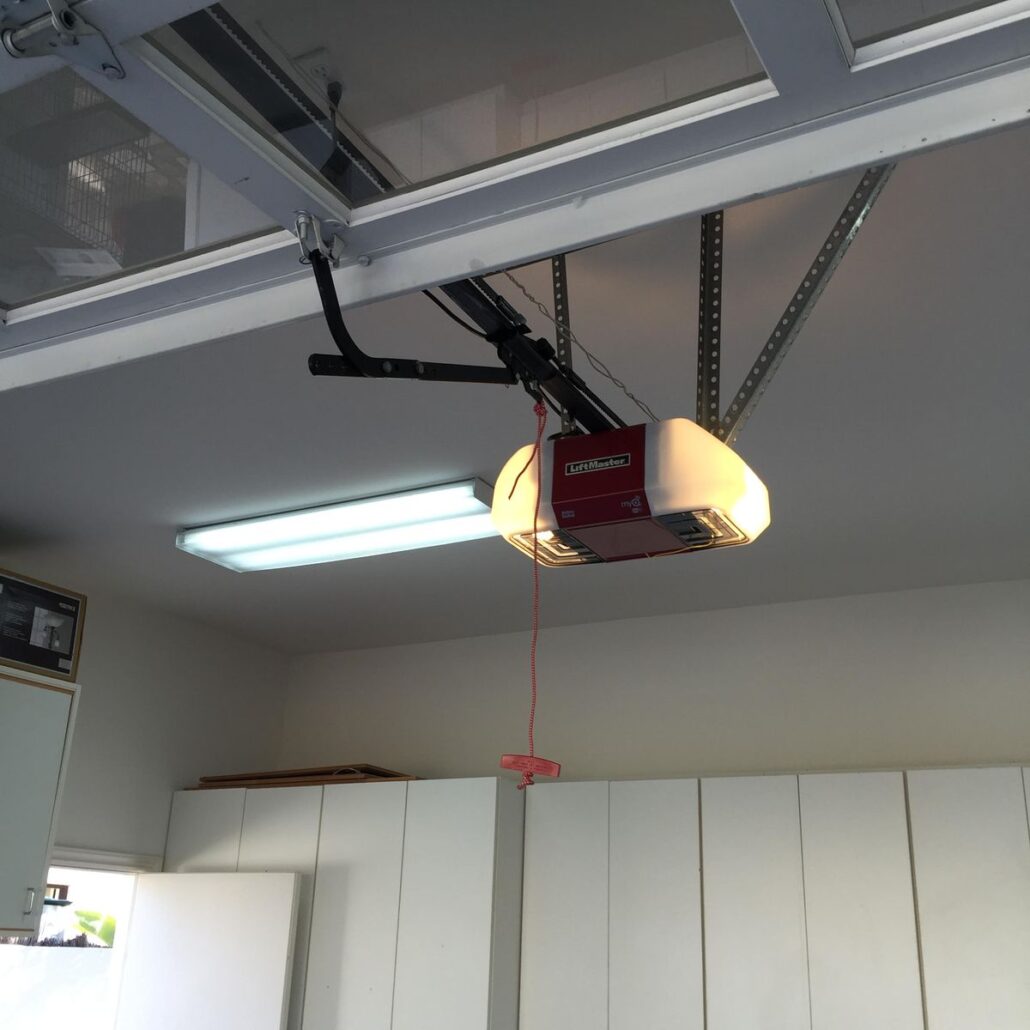
Before you call anyone — including us — there’s a quick test worth doing. Pull the red emergency release cord hanging from the trolley. This disconnects the door from the opener drive. Now try to lift the door manually.
If the door goes up smoothly and stays up, the opener is the problem. If the door is extremely heavy, won’t stay up, or only opens partway, you likely have a broken spring or a garage door cable repair issue — not an opener problem at all.
This test takes 30 seconds and can save you a service call where the technician has to explain that the unit you were ready to replace is actually fine. We’d rather you have that information upfront.
Is Your Garage Door Giving You Trouble?
Dealing with a broken garage door? Our experienced technicians provide quick, dependable repairs for broken springs, damaged openers, off-track doors, and more. We deliver quality workmanship and prompt service to get your garage door working safely again.
Repair vs. replace: how to make the call without wasting money
Here’s our honest take after a decade of opener work across Pittsburgh:
Repair makes sense when:
- The opener is under 10 years old
- The failure is a single component (logic board, drive gear, capacitor, sensor)
- Parts are still manufactured and available for the model
- The repair cost is less than half the price of a new unit installed
Replacement makes sense when:
- The opener is 15+ years old and parts are discontinued
- It’s had multiple repairs in the past two or three years
- It lacks modern safety features (auto-reverse, rolling code encryption)
- The motor is burned out — that’s rarely worth fixing on an old unit
We’re not in the business of selling you a new opener when a $80 gear kit fixes the problem. But we’re also not going to patch a 20-year-old unit and bill you again in six months when something else fails. Part of our job is giving you that straight answer.
If you’re weighing your options, take a look at our breakdown of top-rated garage door openers to understand what the current generation of units can do — especially around battery backup, smart home integration, and quieter belt or direct-drive mechanisms.
When to stop waiting and call a pro
Some opener problems are fine to monitor for a day or two. Others aren’t.
Call us the same day if:
- The door is stuck fully open (security risk, especially overnight)
- The door is stuck partially open and won’t respond to anything
- You smell burning from the opener unit
- The opener runs continuously and won’t stop on its own
Schedule within the week if:
- You’re hearing new grinding or rattling sounds
- The door is reversing inconsistently
- Remotes are becoming unreliable
For Pittsburgh homeowners who can’t afford to have a stuck door on a cold night, our garage door same-day service is available for exactly these situations. We cover the full metro — from the North Side neighborhoods to communities well east and south of the city.
How we handle opener repairs differently than the big overhead door companies
Pittsburgh has a handful of large overhead door outfits — the kind with commercial fleets and heavy focus on new installs for builders and industrial garage door company accounts. That’s a different business model than ours.
We run a tighter operation specifically focused on residential repair. That means when you call us, you’re not waiting three days for a scheduling window because a big commercial job jumped the queue. We stock common logic boards, drive gear kits, trolley carriages, and sensors in the truck — not just for the best garage door installers’ preferred brands, but for the older units that the big guys sometimes won’t touch anymore.
We also work across the whole Pittsburgh region. Whether you’re in an older row home near the city or a newer build farther out, we’ve seen every configuration — overhead doors, garage layouts with low headroom clearance, ceiling-mounted units with awkward rail angles. There’s nothing novel about Pittsburgh garages to us.
Frequently Ask Questions
Frequently Asked Questions About Garage Door Opener Problems
Most quality openers have a practical lifespan of 10 to 15 years with normal use. Units that cycle multiple times a day, or that were installed in uninsulated garages with wide temperature swings (very common in Pittsburgh), tend to land closer to the 10-year mark.
The flash pattern is a diagnostic code. Most brands use a specific number of flashes to indicate specific faults — sensor misalignment, limit switch issues, motor overload, and so on. Count the flashes and check the label on the back panel of the opener head. If you can’t find the key, call us and describe what you see — we can usually identify the fault code over the phone.
Swapping a remote battery, realigning sensors, or resetting the limit switches are all reasonable DIY tasks. Replacing the logic board, drive gear assembly, or anything involving the wiring inside the unit is best left to a technician. Opener units carry capacitors that hold a charge even when unplugged — that’s a real shock risk if you’re not familiar with the internal components.
Cold temperatures thicken lubricants, stiffen rubber components, and can cause metal to contract slightly — all of which add resistance to the door’s movement. If your opener is already working near its force limits, winter is when it’ll finally give up. It’s usually a sign the opener is aging or the door needs lubrication and tune-up, not just a seasonal quirk.
Honest answer: usually not. Parts availability gets thin beyond 15 years, labor costs approach or exceed the price of a new unit, and older openers lack rolling code security technology that prevents code-grabbing. We’ll tell you the same thing in person — there’s no point in throwing money at a unit that’s past its practical life.
Ready to stop guessing and get a straight answer about your opener? Our team serves Pittsburgh and the surrounding communities, and we’re available for same-day diagnosis when your situation can’t wait. Give us a call or reach out through our contact page — describe what you’re hearing or seeing and we’ll tell you exactly what we think it is before we ever pull out of the driveway. No pressure, no upsell. Just honest garage door help from people who do this every day.